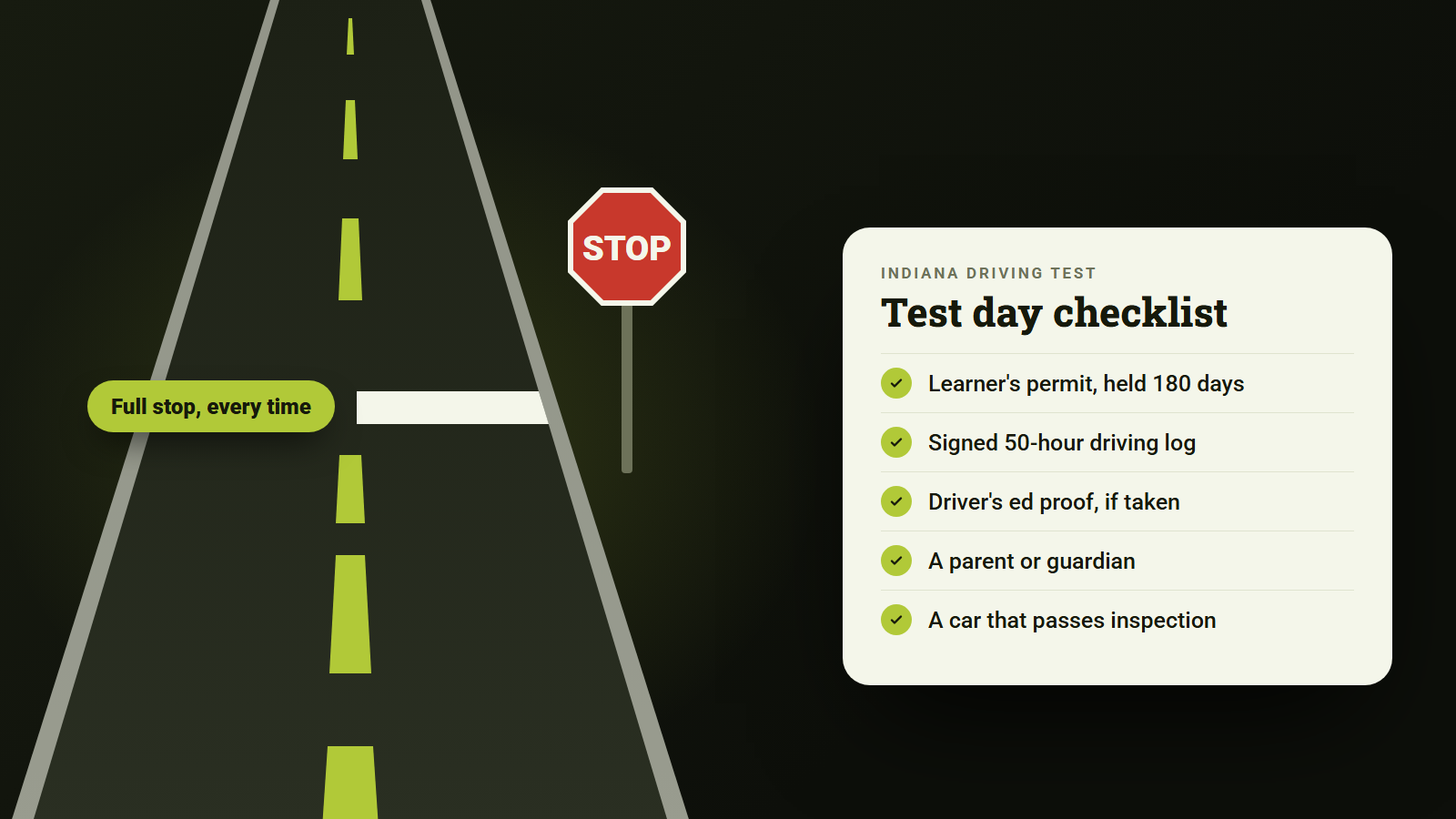
Your teen has logged the hours, held the permit for six months, and now there’s one thing left between them and a license: the driving test. Most of what goes wrong on test day happens before the car leaves the lot, with a missing form, a burned-out brake light or an appointment that was never booked.
Here’s how the Indiana driving test works, from booking it to driving away with a probationary license.
Is your teen ready to test?
Before you book anything, check that your teen meets all of the rules on the BMV’s probationary license page:
- They’ve held an Indiana learner’s permit for 180 days. That’s about six months, counted from the day the permit was issued.
- They’re old enough. At least 16 with a completed driver’s education program, or at least 16 years and 270 days without one.
- The 50 hours are logged. At least 50 hours of supervised practice, with at least 10 of them at night, on a signed log.
Age 16 for driver’s ed students is new. Since July 1, 2026, teens who finish driver’s ed no longer wait the extra 90 days, and Tom Simmons of Simmons Driving School confirmed the change with the state BMV in October 2026. The BMV’s driver’s license page shows 16, but its driving test page still says 16 years and 90 days. If a branch quotes the older age, mention the July 1 change.
The 180 days are the part families most often get wrong. The clock starts on permit day, not on the first day of driver’s ed, so a permit picked up late means a license that comes late too.
Two places to take the test
At a BMV branch. The BMV requires an appointment for every driving test at a branch.
With a driving school. BMV-licensed driving schools can give the driving test, and many include it in their program. Simmons Driving School in Terre Haute is one of them. A school can only do it if it takes part in the BMV’s skills test program, so ask yours.
When your teen tests with a driving school, they take the test in the school’s car. A teen has to test at a branch instead if their permit has expired, their school doesn’t take part, or they didn’t pass driver’s ed. The BMV’s driving test page lists these rules.
How to schedule a driving test at a branch
Book at least 48 hours and no more than three weeks ahead. You can schedule online through myBMV and pick a branch from the BMV’s branch map.
Online booking won’t work if your teen’s permit has expired, if they renewed it in the last six months, or if they don’t have a Social Security number. In those cases, call the BMV at 888-692-6841 to book.
On the day, arrive at least 15 minutes early and tell the nearest associate your teen is there for a skills test.
What to bring to the driving test
The BMV’s driving test page lists what your teen needs:
- A valid Indiana learner’s permit.
- The completed, signed Log of Supervised Driving (State Form 54706), showing at least 50 hours, 10 at night.
- Proof they finished driver’s ed, if they took it.
- A parent or guardian, if your teen is under 18. That adult must be there to sign for financial responsibility.
- A licensed driver to bring them. Your teen can’t drive themselves to the test alone.
Parents, the log is the item that gets forgotten. Sign it the night before and put it in the folder with the permit.
Get the car ready for a branch test
At a BMV branch, your teen takes the test in your car, and the examiner inspects it before the test starts. If the examiner decides the vehicle isn’t safe, the test is canceled. The car must be:
- insured to Indiana’s minimum liability coverage, and properly registered
- legally equipped, safe and clean
- working where the examiner checks: both brake lights, all four turn signals, and doors that open and close
- free of a cracked windshield that blocks the driver’s view
- on four regular tires, not a spare
Any driver assistance features, such as lane-keeping or parking assist, have to be turned off for the test. Walk around the car with your teen the day before and check every light.
Only your teen and the examiner ride in the car during the test.
What’s on the Indiana driving test
The test checks the everyday driving your teen has practiced for six months. The examiner watches how they:
- stay in the right lane, follow lane markings and signal before changing lanes
- approach intersections at the right speed, look for other vehicles and come to a complete stop
- handle yellow lights without trying to beat them
- back out of a parking space using mirrors and a look over the shoulder
- pull into a parking space smoothly, after checking mirrors and signaling
Small mistakes cost points. The BMV’s list includes reversing too fast, forgetting to signal, driving with one hand on the wheel and rolling past a crosswalk or stop line.
Other mistakes end the test on the spot, whatever the score. These include:
- running a stop sign, a yield sign or a red light
- not stopping completely at a stop sign or a stoplight
- breaking a school zone or no-turn-on-red sign
- going over the speed limit
- turning into or driving in the wrong lane
- backing over a curb or hitting a parked car
- not wearing a seat belt
- not following the examiner’s instructions
At Simmons Driving School, Tom Simmons says the number one reason teens fail is turning into the wrong lane, and it’s an automatic fail. On every practice drive, have your teen say out loud which lane they’re turning into before they turn.
A rolling stop is the other easy habit to fall into. In the last few weeks, practice full stops, counted out, on every drive.
If your teen doesn’t pass
It happens, and it’s fixable. After a failed test, your teen waits 7 days before testing again. After three failed tests, the wait is two months from the last one.
Keep an eye on the permit. If it will expire before your teen can retest, they’ll need to renew it, and renewing means taking the knowledge exam again.
A passed driving test stays valid for two years, or until the permit expires, whichever comes first.
After the test: the probationary license
A teen under 18 gets a probationary license first, and it comes with rules. The probationary license page sets them out:
- First 180 days: no driving between 10 p.m. and 5 a.m., and no passengers unless a licensed driver 25 or older (or a spouse 21 or older) sits in front. Brothers, sisters and your teen’s own children are the exception.
- After 180 days, until 18: no driving from 11 p.m. Sunday through Thursday nights, from 1 a.m. to 5 a.m. on weekends, or before 5 a.m. on weekdays, unless your teen is going to or from work, school activities or a religious event, or a licensed adult 25 or older rides in front.
- Until 18: no phone while driving, except to call 911.
One thing to do this week
Pull out your teen’s permit and check the issue date. Count 180 days ahead, and if that date is within three weeks, book the test now. Then open the log: if the hours or the 10 night hours are short, you know exactly how much practice is left.
If you log your teen’s drives in the Drive Now app, the app fills in State Form 54706 for you when the hours are done, ready to sign and bring. For everything about logging the hours, start with the Indiana 50-hour driving log.