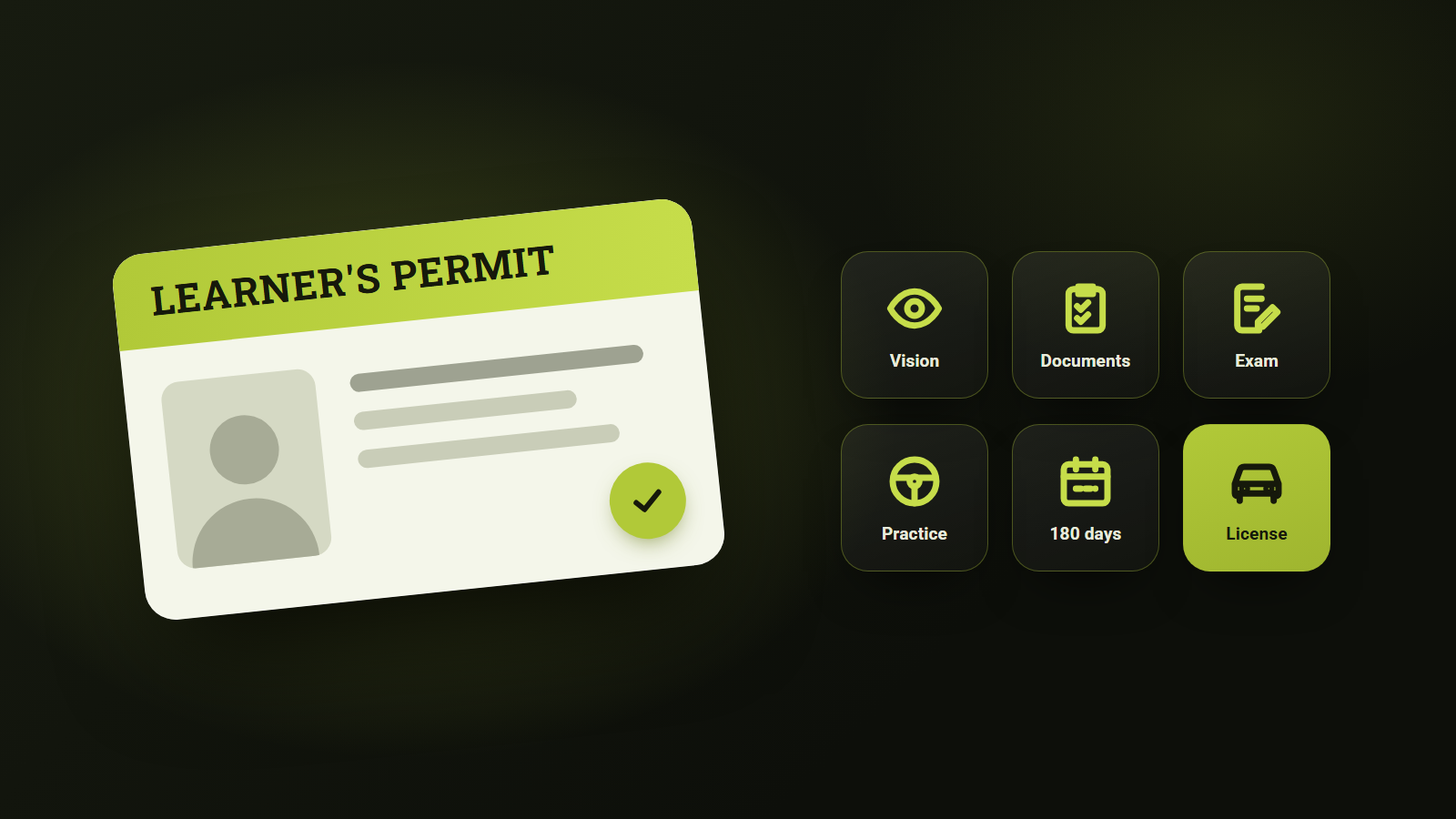
Your teen is counting down to their learner’s permit, and you’d like to get it done in one trip to the BMV. With the right documents and a little studying, one trip is all it takes.
Here’s everything in one place: who can get a permit in Indiana, exactly what to bring, what the knowledge exam is like, and what happens once the permit is in hand.
Two ways to get a learner’s permit in Indiana
Indiana has two routes, and the right one depends on your teen’s age and whether they’re taking driver’s ed. The BMV’s learner’s permit page sets out both.
At 15, with driver’s education. Your teen can get a permit at 15 once they’re enrolled in a BMV-licensed behind-the-wheel program. They’ll bring the Certificate of Driver Education enrollment form from the driving school. Three details trip people up. The first two are in the Indiana Driver’s Manual:
- The enrollment certificate must be dated no earlier than three weeks before the class starts.
- The certificate from the online classroom course doesn’t count. It has to be the behind-the-wheel enrollment.
- Your teen can get the permit up to three weeks before class, but can’t drive on it until class starts.
At 16, without driver’s education. At 16, your teen can apply without a driver’s ed course. They’ll pass a vision screening and the knowledge exam at the branch.
Either way, every applicant passes a vision screening and the knowledge exam, and brings the same set of documents.
What to bring to the BMV
The BMV publishes a one-page learner’s permit checklist. For an applicant under 18, a parent or guardian brings:
- The Certificate of Driver Education enrollment form, if your teen is taking the 15-year-old route.
- One document proving identity.
- One document proving lawful status.
- One document proving the Social Security number.
- Two documents proving Indiana residency.
- An adult to sign the Agreement of Financial Liability on the application, with their own government-issued photo ID.
The back of the checklist lists which documents count in each group. Check them against what you have at home before you go, because one wrong document means a second trip.
If your teen doesn’t have two residency documents in their own name, an adult 18 or older who lives with your teen can sign an Indiana Residency Affidavit at the branch, bringing their own Indiana license or ID and their own proof of residency.
Your teen will also give an emergency contact who is 18 or older, as the Driver’s Manual explains.
Parents, the financial liability agreement matters. By signing it, you agree to share responsibility for injury or damage your teen causes while driving, if your teen is found liable.
The knowledge exam: what to expect
The exam is taken in person at a BMV branch. According to the BMV’s knowledge exam page:
- It’s multiple choice, in two sections: traffic maneuvers and traffic signs.
- Your teen needs 80% or better on each section to pass. A strong score on one can’t make up for the other.
- No appointment is needed. Arrive at least 30 minutes before the branch closes.
- If your teen doesn’t pass, they can try again the next business day.
- The exam is offered in 19 languages.
Everything on it comes from the Indiana Driver’s Manual, which also has sample questions in chapter 9. Here’s one to try at the kitchen table: when can you legally turn left on a red light in Indiana? The answer, from the manual’s practice exam: when you’re turning from a one-way street onto another one-way street.
Have your teen read the manual’s chapters on signs and rules of the road, then work through the sample questions until they’re getting them right without guessing.
What the permit costs and how long it lasts
A learner’s permit costs $9, according to the BMV fee chart revised January 1, 2026.
It’s valid for two years from the day it’s issued. If it expires and sits expired for more than 180 days, your teen will have to take the knowledge exam again to renew it.
Driving on a permit: who can ride along
A permit means practice with a qualified adult in the front passenger seat, every time. For teens under 18, that’s a licensed relative 25 or older, a licensed spouse 21 or older, a driving instructor, or a certified driver rehabilitation specialist.
Our guide to the Indiana 50-hour driving log covers who qualifies in more detail, including how grandparents and other relatives can share the hours.
From permit to license: what comes next
The permit starts the clock on three things your teen needs before a probationary license:
- Time. They hold the permit for at least 180 days.
- Practice. Every new driver in Indiana logs 50 hours of supervised driving, 10 of them at night, whatever their age.
- Age. At least 16 with driver’s education finished, or 16 years and 270 days without, as the BMV’s probationary license page explains. Since July 1, 2026, teens who finish driver’s ed no longer wait an extra 90 days after turning 16.
The most common mistake, says Tom Simmons of Simmons Driving School, is waiting. Families put off the permit, then expect the license on time. The license can’t come sooner than 180 days after the permit, so a late permit means a late license.
The 50 hours take the most planning. Our Indiana driving log guide walks through how to log them, what counts as night and how to fill out the form so it’s accepted.
The hours start with the first practice drive, and that’s where Drive Now helps. The app logs each practice drive by GPS and sorts it into day and night for you. The Indiana BMV accepts the Drive Now app log, and the app is free.
Your first week with a permit: a checklist
- Put the permit somewhere your teen will always have it when they drive.
- Decide who’s riding along. Make a short list of the licensed relatives 25 or older who’ll take a turn.
- Pick how you’ll log the hours, on the paper form or in Drive Now, and log the very first drive.
- Take a quiet first drive in an empty parking lot or a familiar neighborhood.
- Mark the date 180 days out on the calendar. That’s the earliest your teen can apply for a license.
A permit is a big moment. Get the paperwork right once, start the hours early, and the road to a license gets a lot shorter.
Frequently asked questions
Can you get a learner’s permit at 15 in Indiana?
Yes, if your teen is enrolled in a BMV-licensed behind-the-wheel driver education program. They bring the Certificate of Driver Education enrollment form, pass the vision screening and the knowledge exam, and bring the required documents.
What do you need to get a learner’s permit in Indiana?
One document each proving identity, lawful status and the Social Security number, two proving Indiana residency, and an adult to sign the Agreement of Financial Liability. Teens on the 15-year-old route also bring the Certificate of Driver Education enrollment form.
How much is a learner’s permit in Indiana?
$9, according to the BMV fee chart revised January 1, 2026.
How long is an Indiana learner’s permit good for?
Two years from the date it’s issued. If it has been expired for more than 180 days, your teen retakes the knowledge exam to renew it.
Can you take the permit test online in Indiana?
No. The knowledge exam is taken in person at a BMV branch, with no appointment needed.